Joseph Salerno Interview in Daily Bell and Professor Fekete

One of the main objectives of this blog is to apply the Theory of Economic Time from Carlos Bondone.  I do not agree completely with Professor Fekete approach but I have to say that his observations are often brilliant.  What I miss in Fekete is that he has not been able to systematize his views on an organized theory (maybe he is working on it, that would be great).

I was reading an interview with Joseph Salerno on The Daily Bell and it catched my attention when the interviewer asked the following:

Daily Bell:  ……..Dr. Fekete writes then: “The law does not allow the F.R. banks to purchase Treasury paper directly from the Treasury because that would make money creation through the F.R. banks a charade, reserve requirements a farce, and the dollar a sham” He also writes, “The fact is that the Federal Reserve banks can purchase Treasury paper only if they pay with F.R. credit that has been legally created.”

Then Dr. Salerno answers: “Assuming that Fekete has actually said these things, then he is confused, to say the least. I cannot explain exactly what he means, but I will respond to some of his statements.”

I am going to comment just this part of his Dr. Salerno´s answer:

[...] But where does the Fed obtain the funds from that it transfers to the sellers? It literally and instantaneously creates them out of thin air – or in cyberspace – by the stroke of a computer key[...]

Not surprisingly, he really did not understand Fekete´s point.  As I said at the begining, Fekete’s acute views do not fit on orthodox austrian theories, because he is finding flaws. That´s why I think he should systematize all his observations in a theory.  If professor Fekete is open to study it, I am sure he would embrace the Theory of Economic Time, which would be an excellent plattform to further develop his brilliant observations.

Regarding Dr. Salerno´s answer,  “creates them [the funds] out of thin air” is not a fortunate expression at all.  While this is expression would be ok for popular economics, a technical discussion needs much more precission.  This “out of thin air” statement is very frequent amongst many other austrian scholars.    Answering this to Fekete, when Fekete is clearly denouncing that the Fed is creating credit, not money,  makes me think that the “out of thin air” expression is not just rethoric, it is a reflection of a deeper error.

The dollars created by the Fed that Fekete is mentioning  are credit, and they are not backed by nothing.  They are backed by future goods (i.e. bonds, mortgages, etc).  Future goods are far from being nothing.  Does the compromise of paying a mortgage the next 20 years equal to nothing?  Does the future taxation power of the US equal to nothing?  We might dislike the monetizacion of future goods (i.e. debt), but we can not ignore the facts, stating that future goods are “thin air” or “nothing”.

“Mainstream austrians” do not differentiate properly money and credit within their Monetary Theory.  For them, gold and actual dollars can both be money, as long as both of them are used as a medium of exchange.  They are admitting that gold and dollars are within the same scientific category, speaking in terms of monetary theory.  But, it is possible to create gold the same way dollars are created?  the answer is No.  In fact, gold is not created, it is produced.   So we have commodity money (gold) that can not be created at will, and dollars than can be created at the willingness of a debtor and a creditor.  Sure we want to classify them within the same scientific category?

Gold is a present economic good, dollars are credit.   Their scientific nature is extremely different, just as air or vacuum are extremely different concepts, even when both of them may share the utility to keep a ship afloat  in the sea.     Present goods and credit can both be currency, but only present goods should be classified as money, because if we also classify credit as money, then we are indirectly allowing the following aberration: money = credit and gold is money, then gold = credit.

Please, I implore followers of Mises, Hayek and Rothbard to review seriously their monetary theories.  This economic crisis is an open window for austrians to be listened, but with a flawed theory, austrian principles will be ephemeral and the return to unlimited indebted monetary systems will be ensured.   Monetarist and Keynesians will find the way within the current austrian monetary theory to again inject credit as money, because the theory allows this to happen.

This is a brief summary of Carlos Bondone Monetary Theory which i think provides a clear solution from a qualitative point of view:

Currency:  Indirect medium of exchange and unit of account.  Currency Types:

  • Money: Present good used as currency (wheat, gold, silver, deposit certificates of gold or silver, etc.).
  • Credit currency:  Any currency that is not money, it can only be credit.  Then there are the following types of credit currencies:
    • Regular Credit currency:  When the present good that cancels the debt is specified, and so is its quality, quantity and due date.  This is the case for Real Bills or old bank bills that where redeemable for gold or silver.
    • Irregular Credit Currency:  When the present good that cancels the debt is not specifed or its quality or its quantity or its due date.  This is the case for fiat currencies such as dollars or euros.

This categorization and classification of concepts is not a trivial nor a semantic issue.   It has very important scientific implications.   If you don´t think so, just compare the above structure with the following from Mises.  I tried to translate Bondone`s Monetary structure (red labels) to Mises’, and you can see how different they are.  For Mises, commodity money, credit money and fiat money are within the same superior monetary category (Money in the narrower sense or money proper):

* On these cases, Mises scheme was not specific enough to determine which credit currencies are regular and   which ones are irregular

For those of you who are interested, you may find Carlos Bondone online books at www.carlosbondone.com

Manuel Polavieja.

Response to Doug Casey on Bitcoin and Currencies

This is a response to Doug Casey interview on Bitcoins and currencies.   I´ll try to follow the same order of the interview and try to reply his comments whenever I disagree with him.

  1. On his first answer, he talks about a disastrous hack against Bitcoins.  Well, it was not Bitcoins who was hacked, it was a particular private website where bitcoins can be exchanged for dollars.  Bitcoins architecture was absolutely not compromised.  As any other currency Bitcoins may be victim of theft, and that´s because they are valuable!!.   Besides it is zillions of times cheaper triying to steal Bitcoins than trying to compromise its architecture, the same way that is much easier to steal gold than trying to syntethize it, or even mine it.
  2. Regarding Bitcoins price unstability, well to make a fair comparison to gold we would have to know how much gold fluctuated when it first begun to be used as an economic good.   The market does not discover the price of any good inmediatly, it is a process that takes time.  Indeed, it is a dynamic process where a “final” or definitive price is never achieved.
  3. Regarding durability.  Bitcoins are scarce information, represented by bits.  But the very nature of the bitcoins is cryptographic information, just as the economic nature of an mp3 file is the music (information) it contains, not the bits that represent that information.   Information is definetly durable as long as civilization endures.  Of course gold will outlive humankind, but trying to guess the value of anything after humankind is destroyed, is obviously pointless.  Durability of  Bitcoins versus gold is only relevant if civilization collapses very badly (nuclear disaster, strong political totalitarism or similar).  Only in that case and for that reason physical gold´s durability is superior than that of Bitcoin.
  4. When the hackers stole bitcoins at Mtgox, they sold them “any price” and price reached $0,01, but those trades were inmediately canceled.
  5. “Bitcoins are ledger entries”.  Absolutely not.  They are cryptographic information bundled in a computer file, whose property is anonimuosly recorded in a distributed property registry. They are divisible because their design allows them to be.
  6. Do bitcoins have value themselves?  Here is the big issue. No economic good has value by itself or intrinsic value.  As Carl Menger demonstrated all values are subjective and always depend on the perceived utility of the economic good.   Bitcoins render utility as a medium of exchange because they have good monetary properties (durable, relatively scarce,  difficult to fake, divisible, easy  to identify, easy to transport, etc.).   This is not counting other utilities that the market might discover (or not) for Bitcoins (i.e. Namecoins). Besides, what would be the value of gold if for whatever reason it becomes completely useless as medium of exchange or store of value?  Maybe a 20% or 30% of its current value? Is that satisfactory?  But, what kind of event would make gold lose its utility as a medium of exchange? Wouldn´t it be because one or some of its monetary properties (scarcity, durability, divisibility, etc.) fails?
  7. egold is a form of regular credit, you depend on some entity honoring its liabilities or its custodian services.  Bitcoins, just as gold or silver physical bullion, are not anyone else´s liability.  You own them, with egold you have a claim for gold.  It is not the same thing. Here the main difference is that gold is tangible while Bitcoins are not.  That´s why physical gold can´t be transferred electronically and then you need to use claims or ledger entries to achieve maximum portability.   Bitcoin is intanglibe itself, but careful, being intangible does not mean less valuable.  Software or trademarks are intangible and they can be very valuable.
  8. Regarding government shutdown, that´s definetly an important threat for Bitcoins. But shutting down Bitcoin is much more difficult than shutting down e-gold, becuase of its completely decentraliced architecture.   What the governments can perfectly do is to declare it illegal, as Roosevelt did with gold in the 30′s.  Trying to shut down Bitcoins would be a very similar story to that of emule, bitorrent and the like.  For the moment governments have proven impotent with those systems.  In fact, these p2p systems have forced a deep change on the music industry.  Will the monetary industry follow the same pace?  It seems to me that the monetary battle would be way much harder.

Finally both interviewer and interviewed make an assesment about the value of dollars in the future.   Well, their assesment might be right in the long term, but I think they are not considering that the main currency of the world is not dollars but credit used as medium of exchange, and that credit is denominated mainly in dollars.

This is an important difference because one of the very possible outcomes of this crisis is a great credit crunch or margin call, and paradoxically that would make the value of the dollar to skyrocket before collapsing, because if all debts are denominated in dollars, people will need to sell evertything (including gold, silver and bitcoins) to get dollars to pay those debts, and neither the governement or the Fed will get indebted ad infinitum to allow that old debts are paid with newly issued debt (this might look as an endless game, but it is not, just watch Greece, Ireland, Iceland, Argentina or Portugal).

Indeed, both the Government and the Fed  are very close to their leverage limit, and if they get too indebted, they will also be called for margin by the market.

Manuel Polavieja.

Bitcoins and Mises´s Regression Theorem (II)

This is a short update of a previous post about Mises´s Regression Theorem. Mises wrote the following on his Theory of Money and Credit (chapter 8 ):

“Before an economic good begins to function as money it must already possess exchange value based on some other cause than its monetary function. But money that already functions as such may remain valuable even when the original source of its exchange value has ceased to exist. Its value then is based entirely on its function as common medium of exchange”

The bolded part of the paragraph is critical for the consistency of his Regression theorem.   It is not sustainable theoretically to require that a good must have a previous utility before becoming money and at the same time stating that this condition does not have to remain.

He also wrote in Human Action (Chapter 17 section 4 – “The determination of purchasing power of money”):

“Neither a buyer nor a seller could judge the value of a monetary unit if he had no information about its exchange value–its purchasing power–in the immediate past.”

Then, how can a buyer or a seller capabale to judge the value of any new economic good if he had no information of its exchange value –its purchasing power– in the inmediate past?  Why is the utility as a medium of exchange so special that the market is unable to assess it at all?

The market is perfectly capable of discovering any new economic good´s value based on its utility, including monetary utility.  Regression Theorem is supposed to solve a circularity in the sense that people grant value to a good as a medium of exchange because of its purchasing power.   But currency does not have value because of its purchasing power — all economic goods have purchasing power–, but because of its monetary utility (scarcity, divisibility, difficult to fake, etc.) that makes it suitable as a medium of exchange.

If the following statment is inconsistent:  Bread is useful as food because is valuable as food.

So is this one:   Currency X is useful as a medium of exchange because it has value.

The fact is that all economic goods have value because of its utility:

  • Bread has value because it is useful as food.
  • Currency has value because it is useful as a medium of exchange.

Manuel Polavieja

Response to Michael Suede “Against the gold standard”

BitcoinThis article is a response to Michael Suede´s Artcile “Against the gold standard“.

First of all, I would like to state that I am a BitCoin supporter and I also think that gold is and has been the best money around until some other thing is discovered.   Regarding the gold standard , I have a problem with the word “standard” as I think that money should be provided by the free market and not being subject to any other standard or regulation appart from law (civil and trade laws) that would apply equally when providing and exchanging any other goods and services.

That being said, I think it is important to remark the economical nature of Gold and Bitcoins: Both of them are present goods. The fact that gold is tangible and BitCoins are intangible might be a relevant issue, but it is not something new at all.  Software or trademarks are also present goods and they are not tangible.  The most important thing about present goods regarding monetary utility is that they are not anyone else´s liability.

Since I believe Bitcoins are  present goods, and considering the Theory of Economic Time (TTE) from the austrian economist Carlos Bondone, they would qualify as money.  Conversely, currencies that are not present goods can only be credit.   I totally agree whith Michael Suede on his previous article about Bitcoins when he says “In summary, Bitcoins are money because of the properties they have“.   An explanation of why agree with him within the TTE theoretical framework can be found here.    Austrians say that Bitcoins don´t qualify as money because they don´t comply with the Regression Theorem of Money from Mises, which is true, but the problem is that the Regression Theorem is a very unfortunate interpretation from Mises of Menger´s origin of money.   Monetary utility, which is the need for liquidity, is valuable enough by itself, no need a link to anything else to have value.

I understand that Mises could not tolerate that fiat currencies (in fact credit currencies just as he realized) could be used the same way as commodity money, which was the “true money” on Mises perspective.  But that was because he did not separate the concepts medium of exchange (currency) and present good used as medium of exchange (money).   Currencies that are not present goods, can only be credit, and credit might be a currency, but it will never be money (understood as a present good) .  A sound monetary theory has to be unmistakable clear on this: money ≠credit.

Now, regarding counterfeiting and fraud, I do not agree with Michael.  From a theoretical point of view, fraud, theft and counterfeiting are not very relevant, specially when we talk about money or currency.  Because all kinds of currency will always be subject to these risks, including Bitcoins.  Also, any bearer currency such as Bitcoins or physical gold coins, are inherently sensitive to theft.

I also disagree with Michael regarding clearing services (i.e. limiting all transcations to P2P).  I think it will be very hard for Bitcoins to have a wide success with no clearing services at all.  Even transactions involving electronic currencies can be complex and expensive processes, which could certainly be simplified by clearing services.  That would be financial institutions’  role, and I think that it could be perfectly done if all indebtness priveleges they currently have are removed.   Bitcoins could be an excellent pressure to change these laws since they are best suited to work without these institutions, but I have no doubt that Bitcoins would perform better with those sound clearing services.

Also, not all the people have enough knowledge to handle all system security needed to protect bitcoins, and would prefer to ask for a custody service, even giving up anonimity but on the other hand improving security.  A free market surely would cover all needs, and I think this need for security and the aforementioned need for clearing services will always exist.

Manuel Polavieja

El valor del dinero (I)

¿Por qué otorgamos valor al dinero?  Es una pregunta que nos hacemos muchas veces, y que ha sido asunto de largas cavilaciones incluso por parte de los grandes pensadores de la historia de la filosofía.   ¿Como es posible que entreguemos vestidos o alimentos a cambio de unos discos metálicos, se preguntaban?  Hoy día intercambiamos nuestro trabajo y nuestros bienes por pequeños trozos de celulosa con tinta, o incluso nos basta con una simple anotación en la contabilidad de un banco. ¿Por que?

Algunos dicen que es una convención social, otros que son los gobiernos al acuñar moneda los que otorgan valor a esos discos metálicos o trozos de celulosa.   Carl Menger, en su libro principios de economía política hizo un inconmensurable compendio y análisis de este asunto, demostrando de forma muy sencilla que el dinero tiene su origen en el libre mercado y no en ningún otro sitio o ente.

En su observación histórica, muestra como el mercado va seleccionando los bienes que se venden más fácilmente por su alta demanda.  Fue el caso de la sal, el trigo o el ganado.  Además, esos bienes debían tener ciertas propiedades que facilitasen su uso como moneda de cambio.  Por ejemplo que fuese fácil de transportar, homogéneo, relativamente escaso, divisible, que conserve su valor…   El ganado por ejemplo fue usado como moneda de cambio durante mucho tiempo porque se transportaba a si mismo, cada cabeza de ganado era bastante valiosa y relativamente homogéneo, pero sin embargo al ser perecedero conservaba su valor durante un tiempo limitado, solo era divisible una vez sacrificado y además sus divisiones ya no eran homogéneas (un jamón, una paletilla, un lomo…).

Despues de ir testeando multitud de bienes, el mercado acabó por seleccionar la playta y el oro como mejores monedas de cambio.   Con los conocimientos metalúrgicos necesarios, los metales cumplen fácilmente con los requisitos de homogeneidad y divisibilidad, además la escasez y los usos ornamentales del oro y la plata hacían que poca cantidad de metal representase mucho valor, por lo que enseguida superaron con creces al ganado en facilidad de transporte.  Además en el caso del oro su altísima densidad (casi el doble que el plomo) lo hizo extremadamente difícil de falsificar, ya que una moneda falsa es mucho más ligera que una auténtica.

El proceso de acuñación fue una invención práctica del mercado, que sirvió para estandarizar tamaños de moneda y evitar el engorroso proceso de estar pesando las pepitas de oro o plata antes de cada intercambio.  Posteriormente los Estados copiaron el invento de la acuñación, pretendiendo hacer creer que su cuño era lo que otorgaba valor a las monedas.   Pero los hechos han demostrado con tozudez que cuando ese cuño pretende representar un valor arbitrario, a los agentes económicos les trae absolutamente sin cuidado el cuño en cuestión, asignando a la moneda el valor que el mercado “considera” adecuado. La inflación o deflación monetaria es un hecho que demuestra continuamente lo que estamos exponiendo.  En ese sentido, la época en la que el dolar estuvo oficialmente vinculado a una cantidad de oro es una demostración categórica.

Más arriba decíamos que actualmente nos basta con una anotación en la contabilidad de un banco.   Las anotaciones en cuenta son también un medio de intercambio muy interesante, son muy cómodas porque por ejemplo permiten hacer grandes transacciones sin mover una sola moneda de oro de su sitio.

La banca hoy día funciona de forma que nuestras cuentas corrientes son en realidad una deuda que el banco tiene con nosotros, e intenta organizarse de forma que cuando le pidamos lo que nos corresponde, tenga suficiente para satisfacer nuestra petición.   Es decir, estas anotaciones en cuenta son crédito que nosotros le otorgamos al banco.   El crédito o promesa de pago también tiene cualidades monetarias, y las tiene por si mismo sin necesidad de estar referenciado a ningún bien, la solvencia y seriedad del deudor  pueden ser suficientes para aceptar por ejemplo un pagaré.   Además el mercado es muy capaz de valorar el valor de una deuda, basándose precisamente en la solvencia del deudor y en el valor de los bienes que estén en el activo del deudor.

Bien, dicho esto, el economista Ludwig Von Mises elaboró una teoría basándose en la obra de Carl Menger con la que explica porqué las monedas fiat (artificiales) tienen valor.  Esta teoría dice que hay que retrotraerse en el tiempo porque si tiramos del hilo de la historia de la moneda en cuestión llegaremos a un punto en que el valor de la moneda tuvo que estar ligado a algún bien (oro, plata) y que ese bien en algún momento además tuvo valor por uno o varios usos no monetarios (ornamentación, prótesis dentales, etc…).

Sin embargo, el economista Carlos Bondone sostiene que la teoría de Mises no es la más apropiada, ni tampoco una buena interpretación de la obra de Carl Menger.   Bondone propone una teoría más general y por tanto más solida en la que explica que la utilidad monetaria es una utilidad como otra cualquiera y que el mercado está perfectamente capacitado para otorgar valor a la moneda, sea esta un bien físico como el oro, o crédito como el dólar.

Muchos economistas de la escuela austriaca sostienen que la utilidad monetaria no es un fin es si mismo, argumento que me resulta difícil de aceptar desde el momento en que una gran parte de nuestras acciones económicas son pasos intermedios e incluso es habitual que actuemos sin un fin determinado, como cuando en un viaje llevamos efectivo para cualquier imprevisto.   Es más, la moneda cumple precisamente la función de neutralizar la incertidumbre.  Es muy complicado conocer nuestras necesidades a largo, medio incluso a veces a corto plazo, pero si tenemos moneda en nuestro poder, ésta  ejerce de comodín ante cualquier necesidad que nos pueda surgir.   Cualquier cosa que nos ayude a suavizar la incertidumbre del futuro es tremendamente valiosa.

No voy a negar que los bienes que tienen más de una utilidad, sea ésta final o intermedia, tienden a ser más valorados.  Lógico, porque son bienes capaces de cubrir más de una necesidad, por ejemplo el cobre se usa para hacer tuberías, cables eléctricos, o si se funde con Zinc obtenemos latón, aleación que se usaba antes en los barcos porque resistía bastante bien el agua del mar.  Si el cobre tuviese un solo uso sería entendible que el mercado le otorgase un valor inferior.   Por ejemplo, si solo sirviese para hacer tuberías.  Ahora bien, ¿Las tuberías son un fin en si mismo?, ¿ o el fin lo satisface el agua que transportan y por tanto las tuberías son un medio?.

En definitiva, sin perjuicio de que la teoría económica desarrolle el estudio y la diferenciación entre utilidades finales o intermedias, creo que como concepto general se puede afirmar que el mercado valora todo aquello que considera útil (y escaso), independientemente que dicha utilidad sea final o intermedia.  De forma que todo aquello que sea un medio de intercambio generalmente aceptado (moneda), puede ser “legítimamente” útil, y por tanto valioso, tan solo por esa razón.

Manuel Polavieja.

Bitcoins and Mises´s Regression Theorem


I am writing this post in english because I think it might be interesting to a lot of bitcoin supporters.
One of the main bitcoins flaws that austrian economists denounce is that BitCoins don´t have a non-monetary utility, therefore BitCoins don´t have any non-monetary value.    Since Mises stated this requirement on his Regression Theorem, all austrians think that this is a necessary precondition for money.

Menger observed that in a free market usually the most marketeable commodity becomes money, but he never stated that was a mandatory pre-requesite for money.  Mises Regression Theorem was a very unfortunate interpretation of Menger’s observations.

For example, the discovery of gold´s excellent monetary utility could have been achieved before it had any prior non-monetary utility.  In fact, in my opinion using gold as an ornament was a primitive form of minting what already was perceived as having good monetary properties.  Utility is what renders value, not the opposite, and money is not an exception.

Therefore, from a theoretical point of view we must consider the Regression Theorem as unnecessary because monetary utility is valuable enough by itself.  The need for liquidity is the need for certainty on future exchanges, and certainty is impossible to accomplish completely.  That´s why anything that might provide us liquidity on the near or far future is valuable.  So there is no need for previous industrial utility for a good to become money and the use of BitCoins is a categorical demonstration.   And by any means this does not imply that any medium of exchange might be qualified as money, as we will see shortly.

The economist Carlos Bondone demonstrates how the Regression Theorem is unnecessary to explain the value of currency, pages 111 through 114 of his book Theory of Economic Relativity. Carlos Bondone provides a simpler, clearer and stronger monetary theory, following Menger´s principles which Mises, Rothbard, and Hayek did not.  This is a brief summary:

Currency:  Indirect medium of exchange and unit of account.  Currency Types:

  • Money: Present good used as currency (wheat, gold, silver, deposit certificates of gold or silver, etc.).
  • Credit currency:  Any currency that is not money, it can only be credit.  Then there are the following types of credit currencies:
    • Regular Credit currency:  When the present good that cancels the debt is specified, ans so is its quality, quantity and due date.  This is the case for real bills or old bank bills that where redeemable for gold or silver.
    • Irregular Credit Currency:  When the present good that cancels the debt is not specifed or its quality or its quantity or its due date.  This is the case for fiat currencies such as dollars or euros.

As I see it, BitCoins do qualify as money when they are used as currency — which they actually are — because they are present goods, the same way that software or an mp3 file are also present goods.   And they are useful as currency because they have good properties as a medium of exchange:  They are scarce, homogeneus, difficult to fake, easy to identify (this could be improved),  easy to transport, divisible, etc.  The perceived utilitiy of these properties is what makes Bitcoins valuable.    Purchasing power is a consequence of utility, not the opposite.

It would make the BitCoins value more stable if they could be used for a non monetary purpose.  Maybe some cryptographic application?  I think that it would be a good idea for the BitCoin community to research for a non monetary utility for the BitCoins.

As long as BitCoins don´t have a non monetary utility, Mises followers are correct when they say that if BitCoins loses its currency status, then their value would drop to zero, the question is, how much value would also lose silver or gold if they were not used as currency (store of value) anymore?    BitCoins are not risk-free, as nothing in life is risk-free.

Manuel Polavieja.

Bitcoins and Mises Regression Theorem (II) –>

El tiempo como factor de producción y los tipos de interés “negativos”

Me he dado cuenta de que las teorías económicas vigentes, no suelen hablar del factor tiempo a la hora de producir bienes de capital.  No es de extrañar ya que la teoría predominante, que es la Keynesiana, deja mucho que desear en cuanto a teoría del capital.  El profesor Rallo explica muy bien esta carencia.

En mi empeño por poner en práctica la teoría del tiempo económico de Carlos Bondone, voy a intentar hacer un breve análisis de como afecta el tiempo a la producción de bienes de capital.   ¿Que necesitamos para fabricar un bien de capital como puede ser un molino o una furgoneta de reparto?   Pues casi por reducción al absurdo podriamos decir que el ingrediente principal es el tiempo ¿no es así?  Sin que transcurra tiempo, dificilmente podremos fabricar nada.

Creo que las teorías vigentes no tienen en cuenta este hecho porque lo dan por supuesto o como condición imprescindible.   Pero no creo que por eso, por su obviedad u obligatoriedad, haya que ignorar el tiempo como factor de producción, de la misma forma que lo es el acero para fabricar la furgoneta de reparto.

Por otro lado, creo que es importante destacar el papel que juega el tiempo a la hora de obtener o producir bienes presentes en oposición a los bienes futuros.   Los bienes futuros son ideas, compromisos (dentro de un mes te daré un coche), y por tanto crearlos es una tarea que consume una cantidad de tiempo muy pequeña, podríamos decir que muchas veces no será una cantidad de tiempo económicamente significativa.   Por ejemplo, crear un pagaré por 1.000.000€ puede ser cuestión de segundos.

Sin embargo los bienes económicos presentes requieren tiempo para ser obtenidos o producidos, especialmente si son escasos y/o valiosos.   Por eso es tán importante diferenciar entre el dinero y el crédito cuando ambos se utilizan como moneda.  El primero es un bien presente (oro, ganado, sal) y el segundo es un bien futuro (un pagaré o un apunte contable).    En particular, los bienes presentes que además son bienes de capital, suelen ser significativamente valorados, y los que requieren de mucho tiempo para ser producidos suelen ser valorados aún más, ya que de no ser así los empresarios no emplearían su valioso tiempo en producirlos.

El ser humano dispone de un tiempo limitado, es una cuestión natural que estamos obligados a padecer.  Por eso, desde el punto de vista de la economía, es impensable plantearse que el tiempo no tiene valor o que su valor es negativo.  Solo para un difunto esto sería cierto, pero estaremos de acuerdo que las valoraciones subjetivas de los difuntos no entran en el campo de estudio de la economía.  Buscándole tres pies al gato, podríamos decir que un suicida podría no valorar el tiempo, en este caso entonces la percepción subjetiva del suicida es que para él, el tiempo no es un bien económico.  Pero estaremos también de acuerdo en que la gran mayoría de las personas consideran valioso su tiempo, y por tanto otorgan al tiempo la categoría de bien económico.

Por eso, porque el tiempo siempre es un bien económico, y porque el precio de todo bien económico es mayor que cero (de lo contrario no sería un bien económico) el interés, que es el precio del tiempo, no puede ser negativo.    Un precio cero o negativo en economía es como en física pensar que  un objetono tiene masa o ésta es negativa.

Tampoco nos debe confundir lo que se suele llamar “tipos reales negativos”, cuando a los tipos nominales se le resta la tasa de inflación y obtenemos un resultado negativo.   Una cosa es el precio del tiempo, y otra muy distinta una depreciación de la moneda que estemos utilizando como referencia en ese momento.   La inflación no deja de ser una prima de riesgo por impago que se añade al tipo nominal.

Por otro lado, tampoco me gustaría olvidarme de mencionar que es un hecho que el mercado a veces ha descontado “tipos nominales negativos”, por ejemplo las T-Bill a corto plazo cuando la crisis de Lehman.   Pero entiendo que la interpretación correcta de ese hecho es que los compradores de letras estaban demandando (pagando) por mantener su capital a salvo (una especie de pago por servicios de custodia), no debemos entender que estuviesen pagando por prestar.   Esta situación se debe a que el mercado elige de lo peor lo menos malo y ante un temor de quiebra bancaria generalizada, se percibía que el aun solvente Estado americano era una mejor opción que cualquier banco, ya que “gracias” a la reserva fraccionaria no existe la opción de acceder a un verdadero servicio de depósito.

Confusión entre dinero y crédito II

Siguiendo el post anterior sobre la diferencia que existe entre dinero y crédito, voy a hacer una actualización muy breve sobre el tema.  Básicamente se trata de una serie de implicaciones que, a diferencia del dinero (oro, plata, etc.), tiene el uso del crédito como moneda :

  1.  Todo crédito tiene un inicio y un fin, por tanto la moneda basada en crédito tiene una existencia limitada en el tiempo, cuando se amortiza o se impaga, la moneda ligada al crédito sencillamente desaparece del sistema monetario, de la misma forma que apareció.
  2. Por tanto toda moneda creada a partir de crédito es inflacionaria en el momento de su creación y deflacionaria el resto de su existencia.
  3. Cuanto más crédito [deuda] se cree y se monetice, mayor será el flujo de amortizaciones, de forma que cuanta más deuda exista, más crédito nuevo hace falta para mantener creciente el montante total de deuda y por tanto la oferta monetaria.
  4. Si emitimos más moneda [crédito] para solucionar el punto anterior, vamos a peor, ya que seguimos añadiendo más flujo de amortizaciones [deflacionario] al sistema monetario.

Por eso, una burbuja de crédito solo puede acabar de una forma, la única clave del asunto es cuando.

Manuel Polavieja.

La demanda de materias primas y el Baltic Dry Index

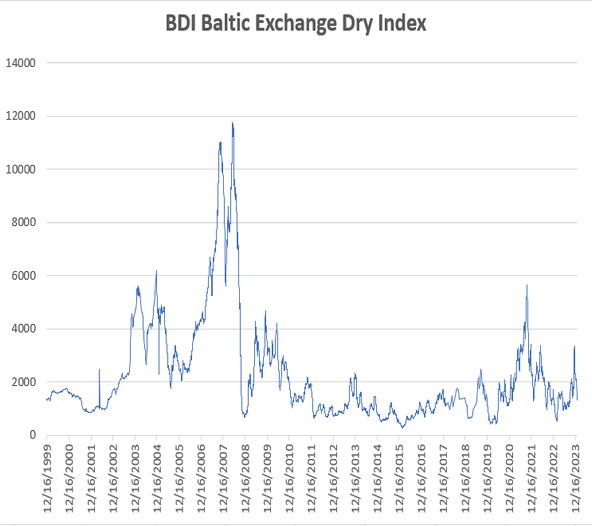
El Baltic Dry Index se encamina a los mínimos de 2008. ¿Los cargueros van vacíos y al mismo tiempo los precios de las materias primas por las nubes? De incremento de demanda lo siento pero nada de nada. ¿Sera escasez? Entonces si los precios del petroleo, del algodon, del trigo, del cobre, del hierro, de la tripa de cerdo, del zumo de naranja congelado, “suben” tanto es porque se están acabando todos a la vez. Vaya, que casualidad!

BDI

BDI

El análisis técnico y la Teoría del Valor Subjetivo

El análisis técnico de los mercados financieros suele ser infravalorado por la gran mayoría de los economistas en favor del análisis fundamental.   Esto se debe a que la mayoría de las teorías económicas vigentes todavía siguen aferradas parcialmente a la teoría del valor objetivo.   Es decir, se basan en que es posible calcular el valor de un bien analizando los elementos que lo componen.   Por ejemplo, que el precio del pan dependerá del precio del trigo, del coste de convertirlo en harina, el coste de amasarlo, hornearlo y transportarlo, etc.

Sin embargo, la Teoría del Valor Subjetivo (TVS) cuyo desarrollo culminó Carl Menger, demuestra que el precio de los bienes se determina en el intercambio, que refleja la valoración subjetiva que las partes hacen de la utilidad de los bienes intercambiados, y que son los costes los que se adaptan al precio fijado por el mercado, no al revés!!.  Menger propone que el valor de los bienes de orden superior (los que sirven para producir otros bienes) depende a su vez del valor de los bienes que produce.   Esta premisa se puede generalizar, ya que si el valor de los bienes de orden inferior (los bienes de consumo) se rige por la teoría del valor subjetivo, entonces los bienes de orden superior también.

Además, podríamos generalizar la propuesta de Menger desde el punto de vista de la necesidad que satisfacen los bienes (utilidad).  Así, los bienes de orden superior también son valorados en función de su utilidad.    Tal y como lo expresa Carlos Bodone:

“…cualquier bien económico surge como consecuencia de que satisface una necesidad humana, no importa en cuál de las etapas esté ubicada esa necesidad, en cuanto a si la hace satisfaciendo una necesidad derivada de la posición de orden superior o inferior; en otras palabras, descubierto el instrumento de capital que permite mayor productividad ya está la necesidad de utilizarlo. De allí deriva su condición de bien económico y formará sus precios incidido por las valoraciones subjetivas.” (Bondone, 2006 p. 97)

Las acciones son bienes de orden superior, que son valoradas principalmente porque dan derecho a participar en el negocio del que son título de propiedad.  Cuando las acciones cotizan en un mercado organizado, la valoración subjetiva de los que participan en ellas queda reflejada en el precio fruto de los intercambios (compras y ventas) de acciones.

La utilidad final que todo poseedor de acciones espera de ellas, es que le aporten un beneficio económico, mediante una combinación de plusvalías y/o dividendo que reporte ganancias netas.  Por otro lado, como ya sabemos por la TVS, las valoraciones subjetivas tienen un carácter ordinal, es decir, están sujetas al orden o prioridad de necesidades del individuo que valora.

Por eso, cuando alguien se dispone a comprar o vender acciones, son mucho más importantes sus propias circunstancias que las circunstancias de la empresa cotizada.    Lo que más les suele importar a  todos los inversores es si van ganando o perdiendo, o también suele ser muy determinante sus necesidades de liquidez.

Por ejemplo, si alguien acumula una rentabilidad del 300% en unas acciones, entra dentro de toda lógica que decida vender y hacer caja aun cuando piense que las perspectivas futuras de la empresa cotizada sean muy buenas.  Lo mismo si va perdiendo un 30%, por miedo a estar equivocado y perder aun más puede decidir vender, aunque realmente piense que las perspectivas de la empresa cotizada son buenas, pero la sensación de estar perdiendo con su inversión le lleve a no entender lo que está pasando y por tanto decida salir de esa situación que es insatisfactoria para él.

El análisis técnico lo que pretende es observar lo que los participes están haciendo, y si la tendencia general es compradora o vendedora porque en definitiva son las compras y las ventas, y solo las compras y las ventas, las que determinan el precio de las acciones y por tanto su tendencia.

El análisis técnico proporciona herramientas para intentar detectar tendencias y también para intentar detectar situaciones de extremos de mercado.  Con extremos de mercado me refiero a situaciones de pánico o de euforia.   Detectar estos extremos de mercado es muy valioso para no comprar acciones donde “ya está todo el pescado vendido” (euforia) o para detectar buenas oportunidades en situaciones en que se venden acciones a precios de ganga (pánicos).

En un próximo artículo entraré un poco más en detalle sobre el análisis técnico.

cualquier bien económico surge como consecuencia de que satisface una necesidad
humana, no importa en cuál de las etapas esté ubicada esa necesidad, en cuanto a si la hace satisfaciendo
una necesidad derivada de la posición de orden superior o inferior; en otras palabras, descubierto el
instrumento de capital que permite mayor productividad ya está la necesidad de utilizarlo. De allí deriva
su condición de bien económico y formará sus precios incidido por las valoraciones subjetivas